
Home / Injection Molding
Injection Molding Service
Wontech specialize in delivering precision injection molding solutions from concept to mass production. Leveraging advanced equipment, expert engineering, and rigorous quality control, we ensure every part achieves exceptional quality, consistency, and cost-effectiveness. We are committed to being your reliable one-stop manufacturing partner, regardless of your industry.
What Is Plastic Injection Molding?
Injection molding is the predominant manufacturing process for producing plastic parts. It accommodates a wide range of materials, with thermoplastic and thermosetting polymers being the most prevalent.
The process requires three fundamental components: an injection molding machine, raw plastic material, and a precision mold. Within the machine’s injection unit, the raw plastic is melted. This molten material is then forcibly injected into the mold cavity under high pressure. Heat is removed through cooling channels circulating water within the mold, causing the part to solidify. Once cooled, the mold opens, and the finished part is ejected. This entire cycle, typically completed in seconds, is repeated for high-volume production.The key steps in injection molding: Clamping,Plasticization & Metering,Injection,Cooling & Solidification,Ejection.
We have mastered various special injection molding processes, including:
Insert Molding
Overmolding
Gas-Assisted/Water-Assisted Injection Molding
Low-Pressure Injection Molding
BMC (Bulk Molding Compound) Injection Molding
Hot Runner Injection Molding

What Is Plastic Injection Molding?
Injection molding is the predominant manufacturing process for producing plastic parts. It accommodates a wide range of materials, with thermoplastic and thermosetting polymers being the most prevalent.
The process requires three fundamental components: an injection molding machine, raw plastic material, and a precision mold. Within the machine’s injection unit, the raw plastic is melted. This molten material is then forcibly injected into the mold cavity under high pressure. Heat is removed through cooling channels circulating water within the mold, causing the part to solidify. Once cooled, the mold opens, and the finished part is ejected. The key steps in injection molding: Clamping,Plasticization & Metering,Injection,Cooling & Solidification,Ejection.
We have mastered various special injection molding processes, including:
Insert Molding
Overmolding
Gas-Assisted/Water-Assisted Injection Molding
Low-Pressure Injection Molding
BMC (Bulk Molding Compound) Injection Molding
Hot Runner Injection Molding


When Injection Molding Delivers Maximum Value?
Plastic injection molding is the premier choice for high-volume production of quality parts, perfectly balancing design freedom, cost efficiency, and material versatility.Injection molding delivers maximum ROI when:
- Annual production volume reaches tens of thousands of parts or more.
- Part geometry is complex, featuring undercuts, thin walls, fine textures, or consolidated assemblies.
- Material Versatility,from standard grades like ABS and PC to high-performance thermoplastics like PEEK.
- Specific properties or finishes are required, such as flame retardancy, high strength, food-grade compliance, or specific colors and surfaces.
- Application-critical consistency is needed, with every part demanding near-perfect dimensional stability and uniform physical properties (e.g., in automotive, medical, or electronics).
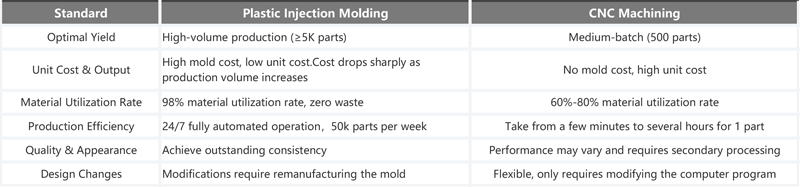
Plastic Injection Molding vs. CNC Machining
| Standard | Plastic Injection Molding | CNC Machining |
|---|---|---|
| Optimal Yield | High-volume production (≥5K parts) | Medium-batch (500 parts) |
| Unit Cost & Output | High mold cost, low unit cost.Cost drops sharply as production volume increases | No mold cost, high unit cost |
| Material Utilization Rate | 98% material utilization rate, zero waste | 60%-80% material utilization rate |
| Production Efficiency | 24/7 fully automated operation,50k parts per week | Take from a few minutes to several hours for 1 part |
| Quality & Appearance | Achieve outstanding consistency | Performance may vary and requires secondary processing |
| Design Changes | Modifications require remanufacturing the mold | Flexible, only requires modifying the computer program |
*The optimal strategy is to use CNC machining for prototyping to validate the design, and then proceed to injection molding for mass production once the design is confirmed.
Our Injection Molding Solutions
Our injection molding service encompasses every step, from initial design to volume production. Through scientific project management and expert process control, we ensure the efficient progression of your project, delivering precision parts with stable quality that meet expectations.

Mold Structure Design
We transform your part design into a functional mold blueprint. This critical phase focuses on gating, cooling, and ejection systems to ensure manufacturability, part quality, and long mold life.

Material Selection & Process Definition
We choose the optimal material and define precise process parameters (temperature, pressure, cycle time) based on your part’s functional requirements and properties.

Injection Mold Manufacturing
Utilizing CNC, EDM, and high-precision grinding, we meticulously manufacture every mold component to the highest standards, ensuring accuracy and durability for mass production.

Mold Trial & Validation
We conduct initial mold trials to produce first samples. This step validates part dimensions, appearance, and identifies any necessary fine-tuning before full-scale production.

Mass Production & Post-Processing
Upon your approval, we will kick off full-scale automated production and handle all required post-processing,such as painting or assembly,and deliver finished parts to you.

Mold Maintenance & Lifecycle Management
Through post-maintenance, our programs prevent unexpected downtime, ensure consistent quality and extend mold life to reduce your total cost of ownership.
Our Injection Molding Workflow
Our injection molding service encompasses every step, from initial design to volume production. Through scientific project management and expert process control, we ensure the efficient progression of your project, delivering precision parts with stable quality that meet expectations.

Mold Structure Design
We transform your part design into a functional mold blueprint. This critical phase focuses on gating, cooling, and ejection systems to ensure manufacturability, part quality, and long mold life.

Material Selection & Process Definition
We choose the optimal material and define precise process parameters (temperature, pressure, cycle time) based on your part's functional requirements and properties.
Injection Mold Manufacturing
Utilizing CNC, EDM, and high-precision grinding, we meticulously manufacture every mold component to the highest standards, ensuring accuracy and durability for mass production.

Mold Trial & Validation
We conduct initial mold trials to produce first samples. This step validates part dimensions, appearance, and identifies any necessary fine-tuning before full-scale production.

Mass Production & Post-Processing
Upon your approval, we will kick off full-scale automated production and handle all required post-processing,such as painting or assembly,and deliver finished parts to you.

Mold Maintenance & Lifecycle Management
Through post-maintenance, our programs prevent unexpected downtime, ensure consistent quality and extend mold life to reduce your total cost of ownership.
Why Chooose Wontech For Injection Molding Services?
Our unique strength lies at the intersection of cutting-edge technology and specialized material mastery, particularly in electric motor components and BMC applications. When you choose us, you’re not just getting parts—you’re gaining a strategic manufacturing partner dedicated to solving your challenges.
Micro & High-Precision Molding Expertise
Leveraging high-precision molds and rigorously controlled processes, we ensure every part achieves exceptional dimensional stability and consistency to meet your most demanding specifications.
- Tight Tolerance Control: The critical dimension accuracy is ±0.01mm
- Micro-Component Molding: Continuous production of components less than 1 gram
- Thin-Wall Molding Technology: Reliable production of parts with <0.8mm uniform walls


- Precision-Molded Parts
- Miniature Parts


- Thin-Wall Molded Parts
- Stable High-Precision Parts
Explore more injection molding case studies
Process & Efficiency Optimization
Proficient in various specialty materials and complex processes, we continuously optimize production through scientific molding, achieving lower costs and higher efficiency for you.Some of various optimization checks include:
- Cycle Time Optimization: Mold cooling optimization, automated part removal, parallel operation workflows
- Design of Experiments (DOE): To systematically define the robust process window by varying key parameters like melt temperature and holding pressure.
- Rheological (Viscosity) Analysis: To define the optimal injection speed profile by characterizing the polymer's flow behavior.
- Pressure drop studies to determine if the machine has enough pressure to move the screw at the set rate.
- Optimize the holding time by conducting gate seal or gate-freeze studies.
Advanced Equipment & Capacity

Injection Molding Equipment
- Possess a range of injection molding machines, including hydraulic, all-electric, and large-tonnage models.
- Product dimensions range from 1 x 1 x 5 mm to 1400 x 1200 x 600 mm.
- Clamping Force Range: 90T – 1000T
Robust Production Capacity
- Monthly Capacity: 2.5+ million mold cycles
- Standard Lead Time: As fast as 1 week (volume-dependent)
- Mold Changeover: < 30 minutes with Quick Mold Change Systems
- Equipment Utilization Rate > 80%
Highly Automated Production
- Robot Integration Rate > 90%
- Automated Material Handling Systems in place
- Mold Changeover: < 30 minutes with Quick Mold Change Systems
- 24/7 Production Monitoring
Quality Assurance System
“Quality isn’t merely an end-point inspection—it’s a core value embedded throughout the entire product lifecycle.”
Click to View Quality Manual
Advanced Testing Capabilities
Coordinate Measuring Machine (CMM)
Optical Measurement System
Quality Inspection Room
Process Control
15+ SPC Control Points
±0.005mm Inspection Accuracy
100% First Article Inspection (FAI)
Quality Documentation Standard
Certificate of Analysis (CoA)
Material Certification
Dimensional Inspection Report (Sample)
Test Report
Global Certification
ISO 9001 & IATF 16949 (Automotive)
ISO 14001 Environmental Management
ISO 13485 (Medical)
Why Chooose Wontech for Injection Molding Services?
Our unique strength lies at the intersection of cutting-edge technology and specialized material mastery, particularly in electric motor components and BMC applications. When you choose us, you’re not just getting parts—you’re gaining a strategic manufacturing partner dedicated to solving your challenges.
Micro & High-Precision Molding Expertise
Leveraging high-precision molds and rigorously controlled processes, we ensure every part achieves exceptional dimensional stability and consistency to meet your most demanding specifications.
Precision-molded Parts
Precision-molded Parts
Precision-molded Parts
Precision-molded Parts
Explore more injection molding case studies
Process & Efficiency Optimization
Proficient in various specialty materials and complex processes, we continuously optimize production through scientific molding, achieving lower costs and higher efficiency for you.Some of various optimization checks include:
- Cycle Time Optimization: Mold cooling optimization, automated part removal, parallel operation workflows
- Design of Experiments (DOE): To systematically define the robust process window by varying key parameters like melt temperature and holding pressure.
- Rheological (Viscosity) Analysis: To define the optimal injection speed profile by characterizing the polymer's flow behavior.
- Pressure drop studies to determine if the machine has enough pressure to move the screw at the set rate.
- Optimize the holding time by conducting gate seal or gate-freeze studies.
Advanced Equipment & Capacity
Injection Molding Equipment
- Possess a range of injection molding machines, including hydraulic, all-electric, and large-tonnage models.
- Product dimensions range from 1 x 1 x 5 mm to 1400 x 1200 x 600 mm.
- Clamping Force Range: 90T – 1000T
Robust Production Capacity
- Monthly Capacity: 2.5+ million mold cycles
- Standard Lead Time: As fast as 1 week (volume-dependent)
- Mold Changeover: < 30 minutes with Quick Mold Change Systems
- Equipment Utilization Rate > 80%
Highly Automated Production
- Robot Integration Rate > 90%
- Automated Material Handling Systems in place
- Mold Changeover: < 30 minutes with Quick Mold Change Systems
- 24/7 Production Monitoring
Quality Assurance System
“Quality isn’t merely an end-point inspection—it’s a core value embedded throughout the entire product lifecycle.”
Click to View Quality Manual
Advanced Testing Capabilities
Coordinate Measuring Machine (CMM)
Optical Measurement System
Quality Inspection Room
Process Control
15+ SPC Control Points
±0.005mm Inspection Accuracy
100% First Article Inspection (FAI)
Quality Documentation Standard
Certificate of Analysis (CoA)
Material Certification
Dimensional Inspection Report (Sample)
Test Report
Global Certification
ISO 9001 & IATF 16949 (Automotive)
ISO 14001 Environmental Management
ISO 13485 (Medical)
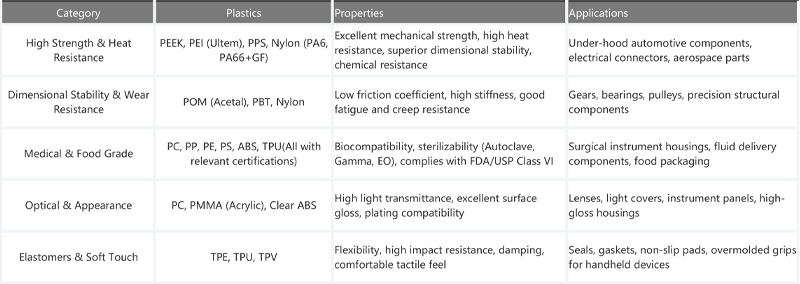
Matching the Ideal Material to Your Application
Successful products stem from an extreme pursuit of detail, and material selection is the first critical step determining performance, durability, and cost-effectiveness. We are not just a molder; we are your material consultant, committed to matching the right plastic to your specific application challenges.

Matching the Ideal Material to Your Application
Successful products stem from an extreme pursuit of detail, and material selection is the first critical step determining performance, durability, and cost-effectiveness. We are not just a molder; we are your material consultant, committed to matching the right plastic to your specific application challenges.
| Category | Plastics | Properties | Applications |
|---|---|---|---|
| High Strength & Heat Resistance | PEEK, PEI (Ultem), PPS, Nylon (PA6, PA66+GF) | Excellent mechanical strength, high heat resistance, superior dimensional stability, chemical resistance | Under-hood automotive components, electrical connectors, aerospace parts |
| Dimensional Stability & Wear Resistance | POM (Acetal), PBT, Nylon | Low friction coefficient, high stiffness, good fatigue and creep resistance | Gears, bearings, pulleys, precision structural components |
| Medical & Food Grade | PC, PP, PE, PS, ABS, TPU(All with relevant certifications) | Biocompatibility, sterilizability (Autoclave, Gamma, EO), complies with FDA/USP Class VI | Surgical instrument housings, fluid delivery components, food packaging |
| Optical & Appearance | PC, PMMA (Acrylic), Clear ABS | High light transmittance, excellent surface gloss, plating compatibility | Lenses, light covers, instrument panels, high-gloss housings |
| Elastomers & Soft Touch | TPE, TPU, TPV | Flexibility, high impact resistance, damping, comfortable tactile feel | Seals, gaskets, non-slip pads, overmolded grips for handheld devices |
More Material Services: including selection advisory, cost-performance optimization, alternative material recommendations, and pre-drying & handling standards.
FAQs For Injection Molding
Quick answers to common questions
“What are your production scheduling and Minimum Order Quantity (MOQ) policies for small to medium-volume orders?”
Regarding Minimum Order Quantity (MOQ), we typically view it from two angles: Tooling MOQ and Production MOQ. For tooling, we generally don’t have an MOQ, but the mold cost needs to be covered.
For production MOQ, we are highly flexible. For small and medium runs, we typically set the MOQ at an economically viable production quantity. This covers the base costs of machine setup, preparing specific materials, and conducting quality inspections. This quantity could be a few thousand pieces, depending on the part and material. We understand you may not need massive inventory, so we aim to find a balance that makes economic sense for both parties.
Concerning Production Scheduling, we manage our capacity through a sophisticated ERP system. Once your order is confirmed, it is slotted into our master production schedule. We provide you with a clear timeline encompassing mold readiness (if applicable), raw material procurement, and production.
“What experience and capabilities do you have for handling products with complex designs?”
Complex part designs are where our engineering expertise truly shines. We possess extensive experience and advanced capabilities to tackle these challenges head-on.
In terms of engineering experience, our team has handled numerous complex designs, such as: parts with deep ribs and thick sections prone to sink marks, which we mitigate by optimizing gate location, cooling, and using techniques like gas-assist molding; precision components with tight tolerances, which we maintain using high-precision molds, strict process control, and Statistical Process Control (SPC).
And parts with undercuts, which require complex mold actions like sliders and lifters – our specialized mold designers are adept at engineering these moving mechanisms for successful part ejection.
Regarding technical capabilities, we rely on advanced tools: We use mold filling simulation software like Moldflow to simulate the plastic flow, packing, and cooling phases before cutting steel. This allows us to predict and resolve potential issues like short shots, air traps, weld lines, and warpage virtually. This proactive approach optimizes the mold design and process parameters, saving significant time and cost.
"What dimensional tolerances can you guarantee for your injection molded products?"
Our standard molding tolerance is ±0.05mm, precision molding achieves ±0.01mm, and ultra-precision special projects can reach ±0.005mm.
Tolerance capability depends on material properties, product design, and mold quality. We conduct DFM analysis during project initiation to establish achievable tolerances. To ensure precision, we employ scientific molding methods with cavity pressure sensors and closed-loop control systems for real-time parameter adjustments.
All precision components are measured in a temperature-controlled environment (20±1°C) using Zeiss CMM equipment. We provide full dimensional reports and implement 100% automated visual inspection for critical dimensions to guarantee batch consistency and reliability
“How do you handle quality issues during the injection molding process?”
Our quality management system is based on the ISO 9001 standard and implements a four-layer protection mechanism: prevention, detection, response, and improvement.
At the prevention level, we conduct a comprehensive process failure mode and effects analysis (FMEA) before production begins to identify potential risks and develop control plans.
At the detection level, in addition to real-time monitoring of process parameters, we have deployed an intelligent vision inspection system capable of identifying surface defects as small as 0.01 mm.
Our three-tiered response team (operator, process engineer, and quality director) ensures that problem handling is initiated within 2 hours and initial assessment is completed within 4 hours. For batch issues, we implement a “red-yellow-green” alert system, with the highest-level alert triggering a cross-departmental war room meeting.
Corrective actions are validated and tested by the DOE before implementation to ensure their effectiveness. We provide a transparent issue tracking portal, allowing customers to monitor the progress of problem resolution in real time.
“How long does it take from mold completion to mass production?”
From mold completion to stable mass production typically takes 2-4 weeks, depending on product complexity, material properties, and quality standards.
Our four-stage process ensures a smooth transition:
The first stage includes mold validation and process development, such as dimensional verification, Moldflow simulation comparison, and gate balancing testing, to determine the optimal temperature and pressure profiles.
The second stage involves mold production and trial molding for comprehensive validation: key dimensions are measured using a coordinate measuring machine (CMM), material physical property tests are performed, and a first article inspection report (FAIR) and control plan are established.
The third stage involves pre-production runs to optimize the production cycle, implement a statistical process control (SPC) system, and validate quality control checkpoints.
The final stage involves completing the PPAP documentation package (including dimensional reports, material certifications, and performance test data), after which customer approval is obtained and initial production can begin.
“How to ensure product consistency in mass production?”
We ensure consistency in mass production through a comprehensive, multi-layered quality assurance system. First, we employ scientific molding methods, establishing robust process windows through Design of Experiments (DOE) to determine optimal parameter combinations, and utilizing cavity pressure sensors to monitor filling consistency in real time for each injection.
Second, we perform daily precision calibration on all equipment and track critical components through a lifecycle management system, proactively replacing them before failure occurs.
Third, rigorous material control establishes a complete traceability chain for all raw materials, including incoming physical property testing and pre-processing drying procedures for specific materials to ensure consistent material properties.
Fourth, we deploy an advanced Statistical Process Control (SPC) system that monitors critical dimensions and performance characteristics through dynamic control limits, stopping operations promptly in case of problems.
Furthermore, we regularly conduct process capability analyses (target Cpk ≥ 1.67) to continuously improve our process windows, ensuring stable quality even during 24/7 continuous production operations.
“What factors affect the cost of injection molding?”
First, tooling investment constitutes the most significant upfront cost, determined by mold complexity, number of cavities, steel grade selection, and expected lifecycle.
Material selection directly impacts per-part costs, with engineered resins like PEEK or glass-filled nylon costing 3-5 times more than commodity plastics like PP or ABS.
Part geometry affects both mold complexity and cycle time—thick sections require longer cooling times, while undercuts necessitate complex slide mechanisms.
Production volume dramatically influences unit economics through amortization; high volumes distribute tooling costs across more parts while enabling automation investments that reduce labor costs.
Tolerance requirements also play a critical role—precision components requiring ±0.01mm tolerances demand specialized equipment, rigorous process control, and higher scrap rates.
Secondary operations such as ultrasonic welding, pad printing, or assembly add substantial labor and equipment costs.
Finally, geographical considerations including labor rates, energy costs, and regulatory compliance requirements create significant regional cost variations.
Partner with Us. Engineer Your Success.
- Get Your Custom Molding Plan
- Download Design Guidelines
- Talk to a Molding Expert

- No.2, South Huatai East Road, Caosan PioneerPark,ZhongShan,Guangdong,China
- +86 13326981626
- ocean.h@wanglai.cn
CAPABILITIES
COMPANY




Copyright ©2026 Wontech | Powered by Wontech.All Rights Reserved.