
Energy-Efficient Injection Molded Rotor: Zero-Eddy PPS Overmolding for Heat Pumps
- October 12, 2025
Project Overview
Industry
Renewable Energy / HVAC Heat Pumps
Component
Permanent Magnet Brushless Motor Rotor
Material
PPS + 40% Glass Fiber Reinforced
Mold Processing
S136 Stainless Steel (HRC 50-52)
Standard
System Efficiency +8%, 6,000V Impulse Clearance, ISO 1940 G0.8 Balance
Protecting Permanent Magnet Rotors Against Electrical Grid Surges
Air source heat pump systems operate year-round in harsh outdoor climates, providing indoor heating and domestic hot water. In cold regions, power grid voltage fluctuations, severe thermal shocks, and continuous seasonal operation place extremely high demands on motor efficiency and structural durability.
Inside a high-efficiency permanent magnet brushless DC motor (BLDC), the rotor carries fragile neodymium magnets. Traditional rotor structures use external stainless steel retaining sleeves or epoxy resin to fix the magnets to the shaft. However, metal sleeves generate eddy current losses, reducing motor efficiency; epoxy resin is prone to aging at high speeds, leading to magnet detachment and failure.
To address these bottlenecks in heat and energy loss, we designed an energy-saving rotor injection-molded from high-performance engineering thermoplastics, completely encapsulating and securely fixing the magnet assembly to the shaft.
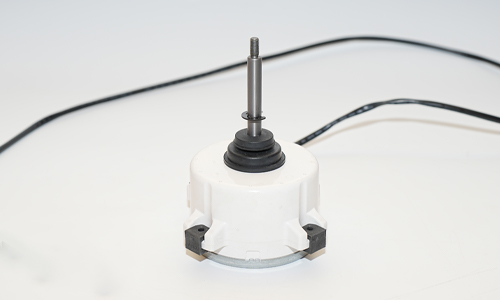
Eliminating Eddy Current Losses Through Thermoplastic Encapsulation
Eliminating Eddy Current Losses Through Thermoplastic Encapsulation
Injecting molten plastic at temperatures exceeding 300°C directly into pre-magnetized or unmagnetized neodymium iron boron (NdFeB) magnets carries considerable risks: thermal demagnetization, hydraulic shock leading to magnet cracking, and axial misalignment.
High-Strength PPS Material Selection
We selected 40% glass fiber reinforced polyphenylene sulfide (PPS). Replacing the metal retaining sleeve with non-conductive PPS material completely eliminates rotor eddy current losses and significantly improves overall drive efficiency.
Low-Shock Injection Profiles
A multi-stage velocity injection method is employed, allowing the molten PPS material to smoothly fill the magnet retaining groove, avoiding thermal shock to the magnet and thus maintaining the magnet’s complete magnetic flux density.
| Rotor Engineering Parameters | Metal Sleeve Reference | Energy-Saving Injection Molded Rotor |
|---|---|---|
| Rotor Sleeve Material | 304 Stainless Steel | PPS + 40% Glass Fiber |
| Eddy Current Loss | High (reduces motor efficiency) | Zero (non-conductive plastic) |
| Voltage Surge Clearance | Requires Additional Insulation | Passes > 8,500V Impulse Surge Test |
| Dynamic Balance Class | ISO 1940 G2.5 | Achieves G0.8 |
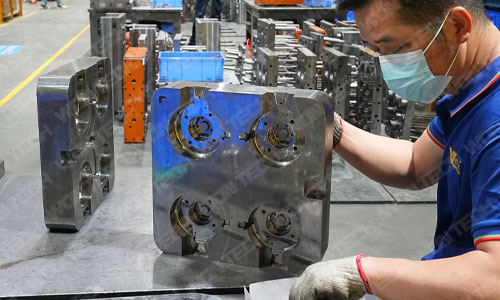
Mold Concentricity and High-Precision Mold Inserts
Maintaining ultra-low runout of the overmolded magnet rotor is crucial for preventing vibration during high-speed motor operation.
- S136 Stainless Steel Tool Steel with High Wear Resistance: The mold core and runner system are made of S136 ESR stainless steel (HRC 50-52). Its extremely high purity and corrosion resistance allow it to withstand high-temperature PPS processing without causing cavity damage.
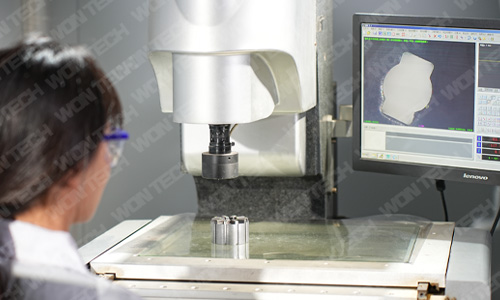
- SPI A2 Mirror Polishing: The magnet positioning grooves inside the mold are optically polished with SPI A2. This ensures easy demolding of parts, avoids dragging, and keeps the shaft concentricity within 0.008 mm TIR (Total Indication Reading).
- 6000V Surge Barrier Geometry: The mold design ensures a uniform 1.5 mm dielectric PPS wall thickness on the magnet assembly, enabling the rotor to withstand a 6000V surge voltage without arc penetration.
Validation: Energy Efficiency and Seasonal Efficiency
The rotor was installed in a heat pump cycle motor and tested on a dynamometer and seasonal energy efficiency test chamber:
- Seasonal Energy Efficiency Factor (SPF) Improvement of 8%
By eliminating eddy current losses and maintaining tight concentricity (TIR < 0.008 mm), the energy-efficient injection-molded rotor improves the overall energy efficiency of the motor system at all seasonal operating points.
- Constant Speed Precision
Under different hydraulic loads, speed fluctuations remained below 0.2%, ensuring stable refrigerant flow and quiet operation.
- Zero Magnet Displacement
The rotor assembly underwent 5,000 hours of rapid speed change durability testing (300 RPM to 6,000 RPM cycles) without magnet displacement or delamination of the plastic casing.
FAQ
How does PPS overmolding improve the efficiency of a heat pump motor compared to stainless steel sleeves?
Stainless steel sleeves are metallic conductors that experience internal eddy currents caused by the rotating magnetic field, generating parasitic heat and power losses. Replacing the metal sleeve with a non-conductive, 40% glass-fiber reinforced PPS jacket completely eliminates rotor eddy current losses, improving total drive system efficiency by up to 8%.
Does high-temperature overmolding demagnetize the neodymium magnets?
No. We control heat exposure through precise multi-stage injection speed control and rapid cavity cooling. During the filling stage, the PPS melt only contacts the magnet surface for a few seconds, keeping the internal temperature of the magnet well below its Curie point and maximum operating threshold, thus preserving 100% of its magnetic flux density.

- No.2, South Huatai East Road, Caosan PioneerPark,ZhongShan,Guangdong,China
- +86 13326981626
- ocean.h@wanglai.cn
CAPABILITIES
COMPANY




Copyright ©2026 Wontech | Powered by Wontech.All Rights Reserved.