
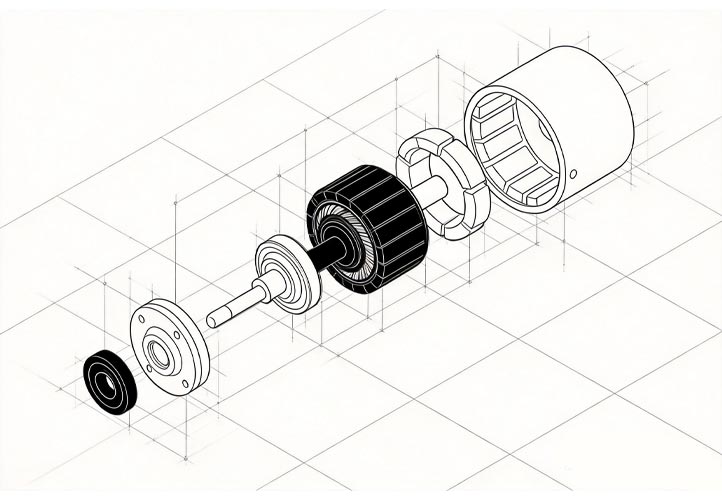
- 1. The Evolution of Electric Motor Plastic Components
- 2. 5 Critical Plastic Applications In Modern Electric Motors
- 3. Comparison of Common High-Performance Materials
- 4. The Core Benefits of Plastics Replacing Metal
- 5. 4 Challenges Faced by Plastic Motor Components in Extreme Operating Environments
- 6. Conclusion
The Evolution of Electric Motor Plastic Components
In the golden age of traditional industrial manufacturing, electric motors were considered “steel behemoths” constructed from copper coils, silicon steel sheets, and cast iron casings. Early plastics, limited by their molecular structure, could not withstand the high temperatures and high-frequency vibrations inside electric motors. Therefore, early plastics were only used as auxiliary sealing gaskets or simple external protective covers.
However, with breakthroughs in polymer chemistry, particularly the emergence of engineering plastics and specialty engineering plastics, modern electric motors have undergone a revolutionary transformation, replacing steel with plastics.
Modern motor plastic parts refer to core structural components processed from high-performance engineering plastics through precision injection molding, multi-color co-extrusion, or insert molding.
These components are widely distributed in the power, cooling, and insulation systems of motors. They are no longer marginal accessories, but critical technological carriers that determine motor energy efficiency, safety factors, and lifespan.
5 Critical Plastic Applications In Modern Electric Motors
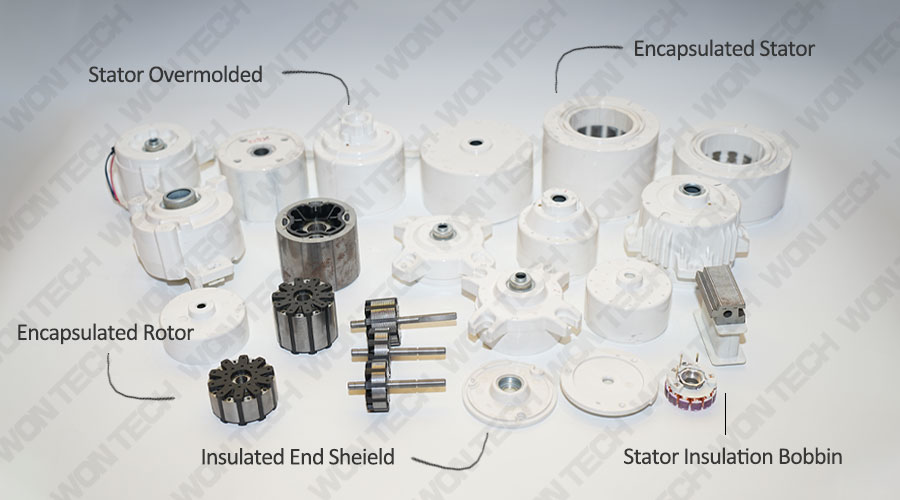
In the industrial chain of precision manufacturing, different motor parts have distinctly different demands on the physical limits of plastics.The following is the distribution of core plastic components in motor.
- High Voltage Resistant Stator Insulation Bobbin
The stator bobbin is the load-bearing core of the electromagnetic coil windings. In micro-motors or servo motors, coils are wound on the bobbin under extremely high tension by highly automated winding machines. The plastic bobbin must not only provide rigid support but also exhibit dielectric strength up to several kilovolts at an extremely thin wall thickness (sometimes even less than $0.5\text{mm}$), absolutely blocking breakdown short circuits between the coils and silicon steel sheets.
- High Speed Dynamic Balanced Fan and Complex Air Deflector
The fan and air deflector bear the heavy responsibility of dissipating heat from the motor core. Traditional aluminum die-cast fans, due to processing tolerances and porosity, find it difficult to achieve ideal dynamic balance and possess huge rotational inertia. Modern high-performance plastic fans are injection-molded in one shot through precision molds, offering extremely high molding precision. While meeting high-air-volume designs, they can easily achieve the G2.5 level dynamic balance standard, significantly suppressing wind noise and bearing vibration at high rotational speeds.
- High Flame Retardant Weather Resistant Terminal Box and Sealing Cover Plate
As the power input hub, the junction box is directly exposed to the external environment. Plastic junction boxes must possess extremely strong resistance to UV yellowing, excellent impact resistance, and stringent flame-retardant standards. Any sparks generated by overheating of the internal terminals must be extinguished by the junction box material itself and must not spread.
- Precision Encapsulated Rotor and Metal Insert Composite Components
As the power input hub, the junction box is directly exposed to the external environment. Plastic junction boxes must possess extremely strong resistance to UV yellowing, excellent impact resistance, and stringent flame-retardant standards. Any sparks generated by overheating of the internal terminals must be extinguished by the junction box material itself and must not spread.
- Low Friction Wear Resistant Bearing Retainer and Special End Shield
In certain silent motors or miniature pump motors, traditional metal end shields are being replaced by integrally injection-molded plastic end shields. It integrates the bearing chamber and brush holder, requiring the material to maintain metal-like stable bearing coaxiality when subjected to long-term axial and radial loads, and to possess an extremely low chemical creep rate.
Comparison of Common High-Performance Materials
The comprehensive shift towards plasticized materials in modern motors is not simply a matter of “reducing material unit prices,” but rather a deep consideration of reconstructing total system cost, energy consumption, and physical properties.
To help engineers make accurate decisions early in the mold design process, we have compiled the following six key physical properties, typical applications, and mold manufacturing challenges of specialty modified plastics used in motors:
| Engineering Plastics | Key Physical Properties | Typical Applications | Requirements for Mold and Process |
|---|---|---|---|
| PA66 + 30%GF | Tensile Strength: ~175MPa RTI: ~130℃ Dielectric Strength: ~30 kV/mm |
Motor cooling fans Air deflectors Protective casings |
Reserve water absorption tolerance; use high-hardness steel |
| PBT + 30%GF | Tensile Strength: ~140MPa RTI: ~140℃ Dielectric Strength: ~35 kV/mm |
Precision stator bobbins Terminal boxes Sensor housings |
High fluidity; mold parting clearance must be within 0.015mm to prevent flash |
| PPS + 40%GF | Tensile Strength: ~195MPa RTI: ~220℃ Dielectric Strength: ~28 kV/mm |
EV motor rotor encapsulation high-voltage insulation end shields |
High mold temp (130℃–150℃) required; necessitates chromium plating and robust venting |
| PA46 + 30%GF | Tensile Strength: ~210MPa RTI: ~155℃ Dielectric Strength: ~25 kV/mm |
High-peak-power servo motor bobbins heavy-duty wear-resistant gears |
High melting point;Runners must be wide and short; gates must avoid stress zones |
| PET + 30%GF | Tensile Strength: ~150MPa RTI: ~155℃ Dielectric Strength: ~38 kV/mm |
Industrial automated motor bobbins high-voltage terminal blocks |
High mold temp (>110℃) required to prevent floating fibers and ensure insulation |
| PEEK + 30%CF | Tensile Strength: ~320MPa RTI: ~250℃ Dielectric Strength: ~22 kV/mm |
Aerospace/military ultra-high-speed bearing retainers slot insulations |
High melt temp (~380℃);Mold must fully use hardened hot-work steel |
The Core Benefits of Plastics Replacing Metal
Based on the superior physical properties of the aforementioned modified engineering plastics, the trend of “replacing metal with plastics” has brought about an irreversible transformation in modern manufacturing.
- System Level Energy Savings from Overall Lightweighting
Comparing aluminum alloy density(approximately 2.7 g/cm³) and modified plastics (approximately 1.3 – 1.6 g/cm³),weight can be directly slashed by over 40%.
For electric vehicles, lightweighting of rotating motor components (such as fans and rotor end plates) not only reduces the overall vehicle weight but also significantly reduces dynamic inertia, shortening the motor’s dynamic response and speed adjustment time by several times.
- Manufacturing Processes Shifts from “Subtractive Manufacturing” to “One Shot Molding”
Traditional die-cast aluminum or cast iron components must undergo complex secondary machining after die casting (such as precision turning of bearing chambers, milling mounting surfaces, drilling, tapping, and tedious deburring). Conversely, high-precision injection molds utilize complex mechanisms like slide cam cores and angled ejector pins to achieve one-shot molding, directly delivering finished goods with micron-level tolerances and bypassing massive post-machining assembly lines and labor costs.
- Elimination of Insulation Safety Redundancy in Assembly Process
Before winding traditional metal stator cores, slot insulation paper must be manually or mechanically inserted, insulating tubes sleeved, or thick insulating varnish sprayed. In contrast, using an integrally injection-molded stator bobbin (such as PBT-GF30 or PA46-GF30) provides an inherent, robust insulation barrier up to tens of kilovolts. This vastly optimizes the internal space of the motor and, by eliminating assembly steps, drives the probability of short circuits caused by “wire scratching and current leakage” to an industrial minimum.
4 Challenges Faced by Plastic Motor Components in Extreme Operating Environments
Although the commercial prospects are vast, the interior of an electric motor is a harsh environment integrating high temperatures, high pressures, intense vibrations, and heavy chemical erosion. These physical characteristics translate directly into four major technical barriers that injection molding shops and mold designers must cross:
- 1- The Battle Between Long Term High Temperature Creep and Material Thermal Aging
Motor insulation classes are generally classified into:
- Class B = 130°C
- Class F = 155°C
- Class H = 180°C
When plastics endure such enclosed high temperatures for long periods, polymer chains are highly prone to cleaving, leading to a cliff-like drop in mechanical strength. If material selection or crystallinity during injection molding is insufficient, components will deform (creep), resulting in motor friction or burnout.
- 2- Sandpaper Like Wear of High Proportion Glass Fibers on Mold Cavities
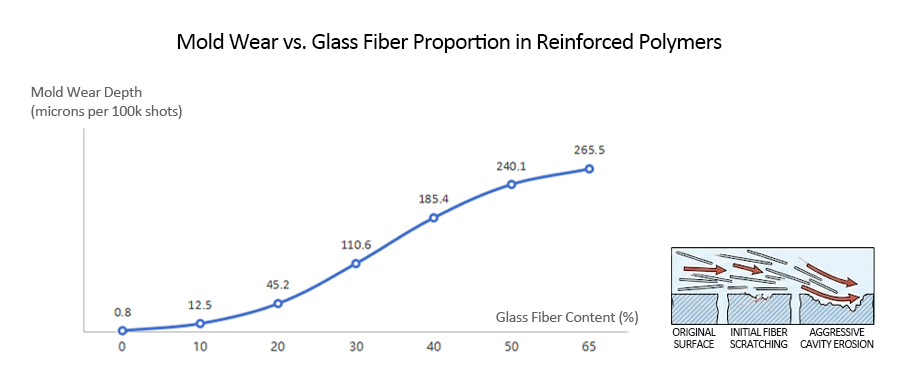
| Glass Fiber Content (%) | Mold Wear Depth (microns per 100k shots) |
Technical Phase |
|---|---|---|
| 0% | 0.8 | Micro Wear (Primarily polymer melt shear wear) |
| 10% | 12.5 | Initial Wear (Glass fibers begin contacting the steel surface) |
| 20% | 45.2 | Accelerated Wear (Fibers collide and scramble within the melt, intensifying abrasion) |
| 30%(Industry Standard) | 110.6 | Severe Wear Phase (Standard wear level for motor bobbins and fans) |
| 40% | 185.4 | High-Risk Wear Phase (Cavity surface roughness deteriorates drastically) |
| 50%(Ultra-High Reinforcement) | 240.1 | Decelerated Wear Phase (Fiber density nears limit, creating a "self-trapping" effect) |
| 60%(Special Limit Grade) | 265.5 | Saturation Phase (Melt fluidity drops extremely low, friction shifts to bulk shear) |
To enhance rigidity, the added glass fiber has extremely high hardness. During high-pressure, high-speed injection molding, the glass fiber in the melt causes extremely severe erosion and wear on the mold’s runners, gates, and cavity surfaces. Once the mold surface is scratched, not only will the product show obvious fiber shedding leading to aesthetic deterioration, but dimensional errors can also render the entire batch of parts unusable. This necessitates special surface treatments for the mold steel, such as nitriding or the use of ultra-high hardness powder metallurgy steel. Controlling warpage due to anisotropic crystallization is extremely difficult.
- 3- High Difficulty Warpage Control Caused by Crystallization Anisotropy
When glass-fiber-reinforced materials flow in the mold cavity, the fibers align along the flow direction. This causes a massive difference in shrinkage between the longitudinal (flow direction) and transverse (perpendicular flow direction) directions (i.e., anisotropy). For flat or multi-cavity motor bobbins, they are highly prone to curling or twisting due to uneven cooling, directly preventing automated winding machines from identifying and positioning them. This heavily tests the balanced design of the mold water cooling system and the precise selection of gate locations.
- 4- Stress Strain Erosion Caused by High Contact with Industrial Chemical Oils
In integrated transmission motors (such as the current mainstream three-in-one electric drive systems in new energy vehicles), plastic parts need to be immersed in ATF (Automatic Transmission Fluid) for extended periods. The oil can subtly penetrate the microscopic gaps between plastic molecules. If significant residual stress is left inside the product during injection molding, the plastic parts will rapidly undergo stress cracking upon contact with the oil, resulting in catastrophic damage.
Conclusion
The evolution of motor plastic parts is by no means a simple “material replacement,” but a profound industrial technological upgrade. From their initial supporting role of providing marginal protection, to now evolving into indispensable performance backbones in new energy vehicles, servo systems, and precision micro-motors, high-performance engineering plastics have proven their value with data. While significantly reducing system weight and improving electric drive energy efficiency, they have also completely reconstructed the internal insulation safety of traditional motors.
Although faced with many severe physical barriers such as high-temperature creep, glass fiber wear, and high-precision dimensional control, these challenges are being conquered one by one with the continuous breakthroughs in material modification technologies and precision injection mold processes.
The future of motor manufacturing will inevitably accelerate toward “all-plastic compounding” featuring higher integration, lighter weight, and smarter manufacturing.
Author’s Note
“As a technical team deeply rooted in precision manufacturing and injection molding, we have witnessed countless motor components transform from metal blueprints to one-piece plastic molding. In actual development, we understand that behind every exquisite motor plastic part lies the physical law of polymer material flow and shrinkage, as well as the micron-level fitting precision of the mold cavity. This article is not only to trace the past and present of motor plastic parts, but also to help you uncover the core technical details hidden behind the finished product from the manufacturer’s perspective. Whether you are a engineer looking for high-performance components or a peer focused on manufacturing processes, we look forward to sharing more practical experience with you and exploring the infinite possibilities of industrial manufacturing together.“
Discuss Your Tooling Requirements
We deliver mold design, plastic raw material compounding, and molding production as a turnkey service.
- Integrated supply chain
- Experts in all types of electric motor molds
- Plastic‑bonded magnet solutions
- Engineered from production experience
Wontech is trusted by industry leaders
- 20+ years
- ISO 9001
- 40+ patents

- No.2, South Huatai East Road, Caosan PioneerPark,ZhongShan,Guangdong,China
- +86 13326981626
- ocean.h@wanglai.cn
CAPABILITIES
COMPANY




Copyright ©2026 Wontech | Powered by Wontech.All Rights Reserved.