
HVAC Motor Stator Plastic Injection Molding: Sub-22dB Quiet BMC Solution
- December 25, 2025
Project Overview
Industry
Home Appliances / HVAC
Component
Air Conditioner Fan Motor Stator
Material
BMC (Bulk Molding Compound)
Mold Processing
NAK80 Core/Cavity (HRC 38-41)
Standard
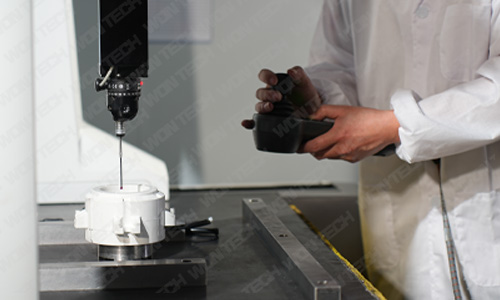
Noise < 22 dB(A), Thermal Conductivity 1.2 W/m·K, Concentricity < 0.012 mm
Silent Motor Engineering: An Innovation in Stator Encapsulation
In residential HVAC systems, indoor and outdoor unit motors operate continuously throughout the long season. Besides electrical efficiency, noise control is a crucial engineering performance indicator. The high-frequency electromagnetic hum and structural vibrations generated during motor operation typically propagate through the metal casing, causing discomfort to users.
Traditional motor stators employ a laminated steel plate structure, secured by external metal brackets or simple insulating paper. This open structure leaves mechanical gaps, leading to vibrations under alternating magnetic fields, and also results in poor heat dissipation from the stator windings.
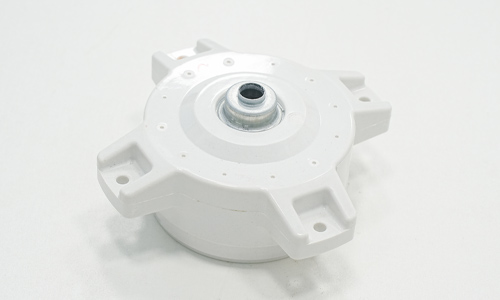
To address these acoustic and heat dissipation challenges, we developed a high-damping HVAC motor stator injection molding solution for a major home appliance manufacturer, encapsulating the entire stator core and copper windings within a special thermosetting plastic.
Overcoming Stator Deformation and Thermal Bottlenecks
Injection molding of motor stators (stator overmolding) places extremely high demands on material flow and mold temperature control. During high-pressure injection, uneven hydraulic pressure can easily cause displacement or deformation of the fragile stator laminations and the tail ends of the copper windings, resulting in inter-turn short circuits.
Customizing the Thermosetting BMC Formulation
We selected a low-shrinkage, high-filling thermosetting block molding compound (BMC). By modifying the resin matrix with mineral fillers, its thermal conductivity was increased to 1.2 W/m·K, almost five times that of standard thermoplastics. This allows heat generated by the copper windings to be directly transferred to the outer surface.
Balancing Multi-Point Injection Pressure
We designed a multi-point gate layout using Moldflow analysis. Molten BMC enters the mold cavity symmetrically from balanced runner locations, thereby equalizing the radial pressure around the stator core and keeping the lamination displacement below 0.008 mm.
| Performance | Standard Thermoplastic | High Damping BMC |
|---|---|---|
| Thermal Conductivity | 0.25 W/m·K | 1.20 W/m·K |
| Sound Loss Factor | 0.012 | 0.048 |
| Linear Shrinkage | 1.2% ~ 1.5% | 0.05% ~ 0.10% (Ultra-low) |
| Dielectric Strength | 18 kV/mm | 24 kV/mm |
Precision Mold Steel and Hydraulic Core Pins
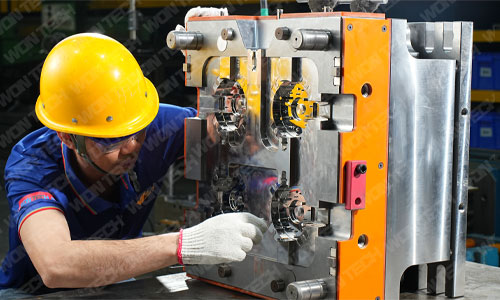
Because the stator’s internal rotor cavity must maintain a precise air gap with the rotor, any plastic flash seeping onto the inner laminations will lead to mechanical friction and acoustic defects.
- Mold steel selection to ensure dimensional stability: We use pre-hardened NAK80 mold steel (HRC 38-41) for both the cavity and core inserts. Its ultra-uniform hardness and fine-grained structure eliminate EDM stress cracking and maintain stability of less than one-hundredth of a millimeter under continuous thermosetting injection cycles.
- Hydraulic Core Expansion Pins: The mold uses expandable hydraulic core pins that tightly clamp the inner holes of the stator laminations during injection molding. This completely seals the inner electrode surfaces, preventing resin flash while maintaining concentricity within 0.012 mm.
Verification: Noise Levels and Temperature Reduction
After trial production, the packaged stator modules were assembled into a complete brushless DC (BLDC) fan motor for bench testing:
- Reduced Sound Pressure
At rated operating speed, the overall motor noise was reduced to below 22 dB(A). The solid-state BMC package completely eliminated the humming noise caused by lamination vibration.
- Reduced Winding Temperature
Under continuous full-load testing, the winding operating temperature decreased by 14°C, extending the motor’s insulation life.
- Zero Assembly Defects
Through balanced casting and rigid mold alignment, lamination deformation was eliminated, achieving a 99.8% first-pass yield.
FAQ
How to prevent lamination line displacement during high-pressure BMC injection molding?
We employ a multi-point symmetrical gating system guided by Moldflow analysis to balance the hydraulic filler pressure around the stator core. Additionally, our molds include a custom-designed hydraulic mandrel pin that expands during clamping, firmly securing the laminations and keeping total winding and lamination displacement within 0.008 mm.
What is the typical lifespan of mold steel used for abrasive thermosetting BMC materials?
BMC is filled with glass fiber and mineral powder, making it more prone to wear than standard thermoplastics. We use pre-hardened NAK80 (HRC 38-41) or hardened H13 tool steel (HRC 50-52) for core and cavity inserts. Combined with localized chrome plating of high-wear gates, our molds reliably achieve a mold life of over 500,000 cycles before major overhauls.

- No.2, South Huatai East Road, Caosan PioneerPark,ZhongShan,Guangdong,China
- +86 13326981626
- ocean.h@wanglai.cn
CAPABILITIES
COMPANY




Copyright ©2026 Wontech | Powered by Wontech.All Rights Reserved.