
Home/About/News/Green Breakthrough in Motor End Caps for New Energy Vehicles
Green Breakthrough in Motor End Caps for New Energy Vehicles
To address the challenges of high power density, our BMC molding technology ensures superior heat dissipation and long-lasting sealing of the motor end caps.
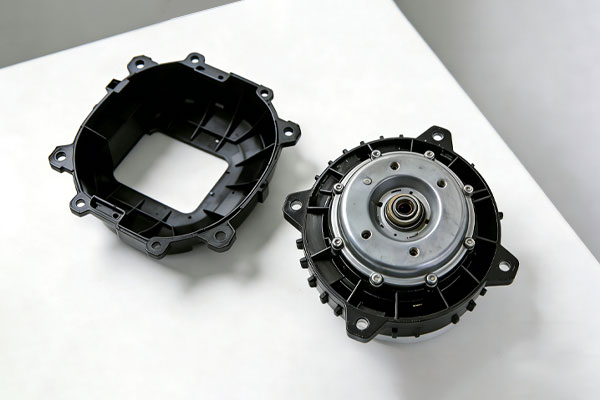
The debate over acceleration performance and driving range in electric vehicles hinges on the electric drive system. Electric motors are evolving towards higher power density, which places unprecedented demands on the heat dissipation capacity and sealing reliability of their core components—such as motor end caps.
A partner who has been cooperating with us for three years to supply new energy vehicle components suggested that the new generation of motor end caps need to effectively dissipate heat under high-speed operation and ensure lifelong oil and dust protection (meeting the IP67 sealing level), while also controlling cost and weight.
Challenge
Heat dissipation bottleneck
The new generation motor design increases power by 40%. During continuous high-speed operation, the temperature in the end cover area can reach over 180°C. Traditional aluminum alloy end covers can no longer meet the heat dissipation requirements.
Seal failure risk
Under high-temperature environments, traditional sealing structures are prone to aging, increasing the risk of lubricant leakage, directly affecting motor lifespan and safety.
Weight and cost balance
It is necessary to control component weight and manufacturing costs while improving performance.
Our Solution
- Customized High-Performance BMC Material
The specially formulated BMC material has a thermal conductivity 3-5 times higher than traditional plastics and a volume resistivity >10¹⁴ Ω·cm, fully meeting the insulation requirements of high-voltage motors. It completely avoids the electrochemical corrosion problems that may occur with aluminum alloy end caps. Its coefficient of thermal expansion is precisely matched to that of internal metal components, reducing thermal stress.
- Mold Temperature Control System
Based on thermal flow simulation analysis, cooling water channels conforming to the curved surface of the mold cavity are arranged directly behind the end cap heat dissipation fins. Critical hot spots utilize a denser, smaller-diameter water channel network, a multi-layered water channel architecture, and intelligent temperature zoning to ensure that the temperature difference between each area is <2℃.
- Innovative design of sealing structure
Precise rubber sealing ring mounting grooves are directly formed in the mold. Utilizing the difference in thermal expansion between BMC and rubber, a special structure is designed that provides a tighter seal at higher temperatures, creating a triple sealing defense to ensure an IP69K protection rating. The sealing structure is designed to last the same lifespan as the motor, eliminating the need for mid-term maintenance.
Results
- Internal temperature rise of the motor during continuous high-power operation is reduced by 13%.
- The end cap passed stringent IP67 dustproof and waterproof tests and long-term oil-proof sealing tests.
- Compared to traditional metal solutions, it is lighter and avoids multiple metal processing steps.
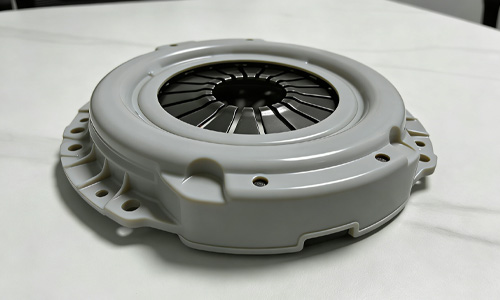
With the widespread adoption of new technologies such as 800V high-voltage platforms, the performance requirements for motor components will become more stringent. We are ready to leverage advanced mold technology to safeguard your next-generation electric drive solutions.
RECENT POSTS
Innovative Technologies In Drones
December 5, 2025
Integrated Design of Intelligent Robotic Vacuum Ceaners
September 20, 2025
ISO13485 Certification Powers Mass Production of Structural Components for Physiotherapy Equipment
June 27, 2025
Have A New Project?
Click to learn more project tips to help you start your project faster.
- Mold Steel Material Selection Guide
- Mold Quality Standard Manual
- Injection Molding Plastic Materials Brochure
- Injection Mold Customization Guide
- Chemically Resistant Materials Document
- Comparison of Various Processes in Injection Molding
- Parts Quality Standard Manual
- Beginner’s Guide to Injection Molding
- Beginner’s Guide to Mold Customization
- Optimal Design of Hot Runner Molds
- Selection of Hot Runner and Cold Runner
CATEGORIES
- Cases and News
- Tips and Guides
- Knowledge Sharing
- Latest Industry News
Customize Your Product

- No.2, South Huatai East Road, Caosan PioneerPark,ZhongShan,Guangdong,China
- +86 13326981626
- ocean.h@wanglai.cn
CAPABILITIES




Copyright ©2025 Wontech | Powered by Wontech.All Rights Reserved.